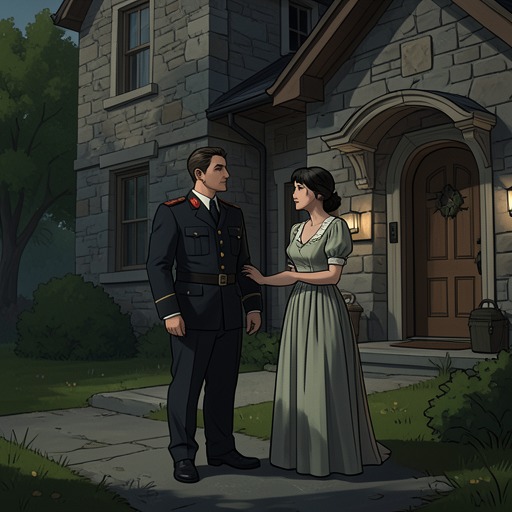
Eliza Barrymore
The Hound of the BaskervillesEliza Barrymore is the wife of John Barrymore, the butler at Baskerville Hall, and the sister of a notorious fugitive hiding on the moor. Her conspicuous grief after Sir Charles Baskerville’s death and her husband’s covert nighttime activity make the household seem ominous; the explanation is not a plot against Sir Henry Baskerville, but a desperate act of family loyalty that Eliza says was undertaken at her urging.
Identity and Household
Eliza is one of only two women said to be living in the house, the other being a scullery-maid. Dr. Watson describes her as large, heavy-featured, and outwardly impassive, with a stern mouth. He also considers her intensely respectable and puritanical, a woman who seems unlikely to be openly emotional. That reserved appearance makes the signs of her distress all the more striking: after a night when a woman’s sobbing is heard, Watson sees that Eliza’s eyes are red and swollen.
She and John Barrymore have served the Baskerville family for generations. Sir Henry notes that their family connection to his own has lasted more than a century and is reluctant to end it as he begins life at Baskerville Hall. The Barrymores, however, explain that they were deeply attached to Sir Charles and have found the house painful since his death. They expect to establish themselves in a business, using the means Sir Charles’s generosity gave them. In the meantime, they offer to remain until Sir Henry has made fresh arrangements, while recognizing that his household may require a larger staff than it did under Sir Charles’s retired way of life.
Grief and Suspicion
Eliza’s sorrow becomes a clue before it becomes an explanation. John denies that his wife could have been the woman crying, although Watson later concludes from her tear-stained face that she was. The denial makes the butler appear to be concealing something, and Watson wonders whether Eliza’s grief points to a guilty memory or whether John is a tyrant in the home. Those are suspicions, not established facts: the evidence Watson sees is her repeated distress and her husband’s evident effort to hide it.
The mystery deepens when Watson follows John through Baskerville Hall at night. Barefoot and carrying a candle, the butler crosses a corridor and enters an empty room. He holds the flame against a window and watches the darkness outside with strained expectation. After waiting, he groans, puts out the candle, and returns along the passage; Watson later hears a key turn in a lock. The scene appears furtive and potentially threatening, but it does not show Eliza’s part in the signal. That connection emerges only when the household’s secret is confronted directly.
The Signal and Its Meaning
When Sir Henry challenges John over the apparent plot, Eliza appears at the door, pale and horrified, and interrupts the accusation. John says that they must leave and tells her to pack. Eliza immediately claims responsibility, insisting that her husband acted for her sake and at her request. Her intervention shifts the scene: the nighttime light was not aimed at Sir Henry, but was part of a system for helping someone beyond the house.
Eliza explains that her younger brother is starving on the moor. The candle at the window signals that food is ready; a light in the distance marks the place where it can be brought. John has been carrying bread and meat to him. Eliza’s account explains both the butler’s watchful vigil and the light that answers from outside, turning an apparent conspiracy into a covert act of assistance.
Family Loyalty and Consequences
Eliza identifies the fugitive as her younger brother and traces his decline to a childhood in which he and his wishes were indulged. As he grew older, bad companions drew him into a succession of crimes that brought disgrace on their family and nearly led him to the scaffold. Yet Eliza’s memory of him remains bound to the boy she nursed and played with as an elder sister. The distance between the notorious criminal he became and the child she remembers helps explain why she cannot simply abandon him.
After he escaped from prison, he knew she was at Baskerville Hall and came there exhausted and starving, with the warders close behind him. Eliza and John took him in, fed him, and cared for him. When Sir Henry arrived, her brother judged that the moor offered a safer hiding place while the search continued. The couple checked on him every second night: if there was an answering light, John carried food out to him. Eliza says they hoped each day that he had gone, but could not desert him while he remained nearby.
Her confession is also an act of protection. She does not deny the secret or minimize the risk to the household; instead, she argues that any blame belongs to her, not John. Her earnestness persuades those listening that the aid was given for her sake. In doing so, she transforms the mystery around the Barrymores from a question of betrayal into a conflict between household duty and kinship: loyalty to the family that employed them gives way, in secret, to Eliza’s refusal to let her brother perish.
Narrative Role
Eliza is introduced through Watson’s interpretation of visible traces—a lie, a candle at a window, swollen eyes—while the motive behind them remains concealed. The sequence makes her grief both a genuine sign of suffering and a misleading clue: it correctly signals that the household is hiding something, but not that the hidden business is directed against Sir Henry. Her explanation then links the emotional mystery to the practical pattern of lights and food.
Her importance rests less on independent investigation than on the choice she makes and the truth she finally speaks. When John is about to bear the consequences alone, she steps forward, names herself as the cause, and reveals the arrangement. The disclosure does not erase the danger created by sheltering a fugitive, but it changes the moral meaning of the couple’s secrecy and clarifies Eliza’s defining conflict: she is prepared to risk her place in the house rather than abandon her brother.